



As you might, we are watching white collar service businesses get quietly hollowed out in real time. A $100K branding RFP we had on the table shrunk to $10K mid-process after we ran the scope through Claude. Same week, a legal professional we work with drafted a full ESOP in Claude and got a bulge bracket law firm to just review it for $1K instead of the $20K they originally quoted.
If you are reading this thinking you had a moment like that recently too, you probably did. We are not breaking news here. The question Shub and I keep coming back to is:
Who actually captures the value as AI makes knowledge work this cheap?
This Week On Practical Nerds - tl;dr
AI insourcing is shrinking white collar service TAMs fast.
Service businesses with physical intervention and high-stakes outcomes will survive.
VCs backing AI-powered service firms may be betting against themselves.
The insurance framework explains which services you should stop buying.
If the cost of being wrong is reversible, insource it now.
🎧 Listen To This Practical Nerds Episode
AI insourcing is putting pressure on white collar service TAMs fast
We were running an RFP process for brand agencies. The setup was completely standard. You warm up the agencies, you learn their methods, you write the RFP, you send it out. Classic $100K project scope. Strategy workshop, website, PowerPoint deck, some offline sales collateral. The agencies had already pitched their process. Everything was lined up.
Then Claude AI for design launched.
I told my colleague to stop the process entirely. Just play with the tool first. Come back and tell me which parts of the RFP we no longer need. My colleague came back and said 80 to 90% of the scope was gone. What could have been a $100K engagement for the selected agency became a $10K project. In one week. The only thing we still wanted from the outside was the creative direction - the tone, the stylistic choices. And honestly, I give that another year before that goes too.
The second example came from a colleague who used to work at a bulge bracket law firm. A startup needed an ESOP drafted. The law firm, reputable firm, reputable lawyer, came back with a quote of around $20K. My colleague looked at that number and thought, let me just try this in Claude first. He drafted the entire ESOP. Then went back to the law firm and asked only for a review. The quote for that came back at $1K. So from $20K down to $1K. A 95% cost reduction. And he was still deciding whether even that review was worth it - which would make it 100%.
These two examples happened in the same week. To people in our immediate circle. And what they pointed to was not productivity. It was insourcing.
Shub and I kept coming back to elevator operators. When elevators were first introduced, every single one had an operator. The technology was new, the pulleys were complicated, it made sense to have someone there. But as the technology matured, people started to realize something. The outcome they wanted - getting to the right floor - was completely within their own reach. There was no reason to have another person in that loop anymore. Once you see that, you cannot unsee it.
Our observation is that this is exactly the moment we are in with white collar knowledge work. The interface between buyer and service provider is collapsing for an enormous range of tasks. Not because AI is perfect. But because the cost of being wrong is low enough that people will take the trade.
And that last part is the key principle. If the probability of error is low and the consequence of that error does not ruin you, you should insource it. A slightly imperfect NDA from two years ago is not going to destroy a business. Taxes filed with a small error are typically fixable. An accounting firm charging you $50K a year for work you could now do in Claude at a fraction of that cost is a line item that, once you see it, you will want to cut.
The insourcing wave is not a future threat to white collar service businesses - it is already compressing their TAMs in real time.

Service businesses with physical intervention and high-stakes outcomes will survive
Not every service business is equally exposed to this dynamic. Shub and I worked through what we think are the four characteristics that give a service business a genuine moat in this environment.
The first is physical intervention. If your service requires boots on the ground, hands on materials, or actual presence in the physical world, a prompt cannot replace it. Installer businesses, construction services, robotics integration. Nobody is going to generate their way to a fixed fence or a correctly wired electrical panel. We are not at the point where AI helps you build a brick wall yourself. Blue collar services involving physical workflows are structurally different from white collar knowledge work, and our view is that distinction matters enormously when thinking about which businesses are exposed.
The second is catastrophic downside risk. This one came out of a lunch I had in LA last year with a very successful insurtech founder in the US. He had built a creative new insurance product designed specifically for founders. And in explaining the logic behind it, he gave me a framework I have not been able to stop using. His point was that people overbuy insurance constantly. They insure things that, if they go wrong, will not ruin them. AppleCare is his example, and I think it is a perfect one. A broken iPhone does not ruin you. You do not need insurance for that. You need insurance for the thing that, in the one-off chance it happens, genuinely destroys you. Health insurance in the United States. Hurricane insurance on your home. That is what insurance is actually for.
The same logic applies directly to services. If the one-in-a-hundred bad outcome from AI-generated output can genuinely ruin your business or your life, you keep the expert. Structural engineering is a clear case. Flying a plane is an even cleaner one. I asked a room of people once - left, current autopilot, right, AI-piloted plane, which one are you boarding? Not one person in that room chose the AI-piloted plane. There is no upside to it. There is only the catastrophic downside. That is the mental model.
The third characteristic is situations where there is unequivocally one correct answer, or a tight set of correct answers. Interestingly, this is where many knowledge services already fail their own test. Law firms famously answer almost every question with "it depends." That is not guidance. It is a compass showing you where North, South, East, and West are and asking you to figure out the route yourself. Most legal, tax, and accounting questions do not have a single catastrophically wrong answer. They have acceptable ranges and AI can navigate those ranges well enough. But structural engineering, aviation, medical diagnosis in high-risk scenarios - these require hitting a specific target. The margin is narrow and the stakes are high enough that human oversight remains essential.
A fourth one that Shub raised, and that we think will become more formalized over time, is verification and authentication. As AI generates more and more output - documents, financial models, legal drafts, brand strategies - someone needs to check that human intent and accuracy have been preserved. Right now this lives mostly in professional instinct. A domain expert's gut sense that something is off. It is not yet a properly formalized outsourced service. But our sense is it may become one.
Industries that hit two or three of these characteristics are not just surviving the insourcing wave. Our observation is they can actually capture the efficiency value that AI creates rather than watching it leak to the customer. In regulated industries, pricing is partially fixed anyway. In high-reputation industries, stickiness and premium pricing are structural. Give those service providers better AI tooling and they keep the margin uplift. The efficiency gain does not flow down to the buyer. It stays in the business.
We observe that service businesses where being wrong is expensive, irreversible, or physically consequential are the ones that will thrive - AI makes them more efficient without making them optional.
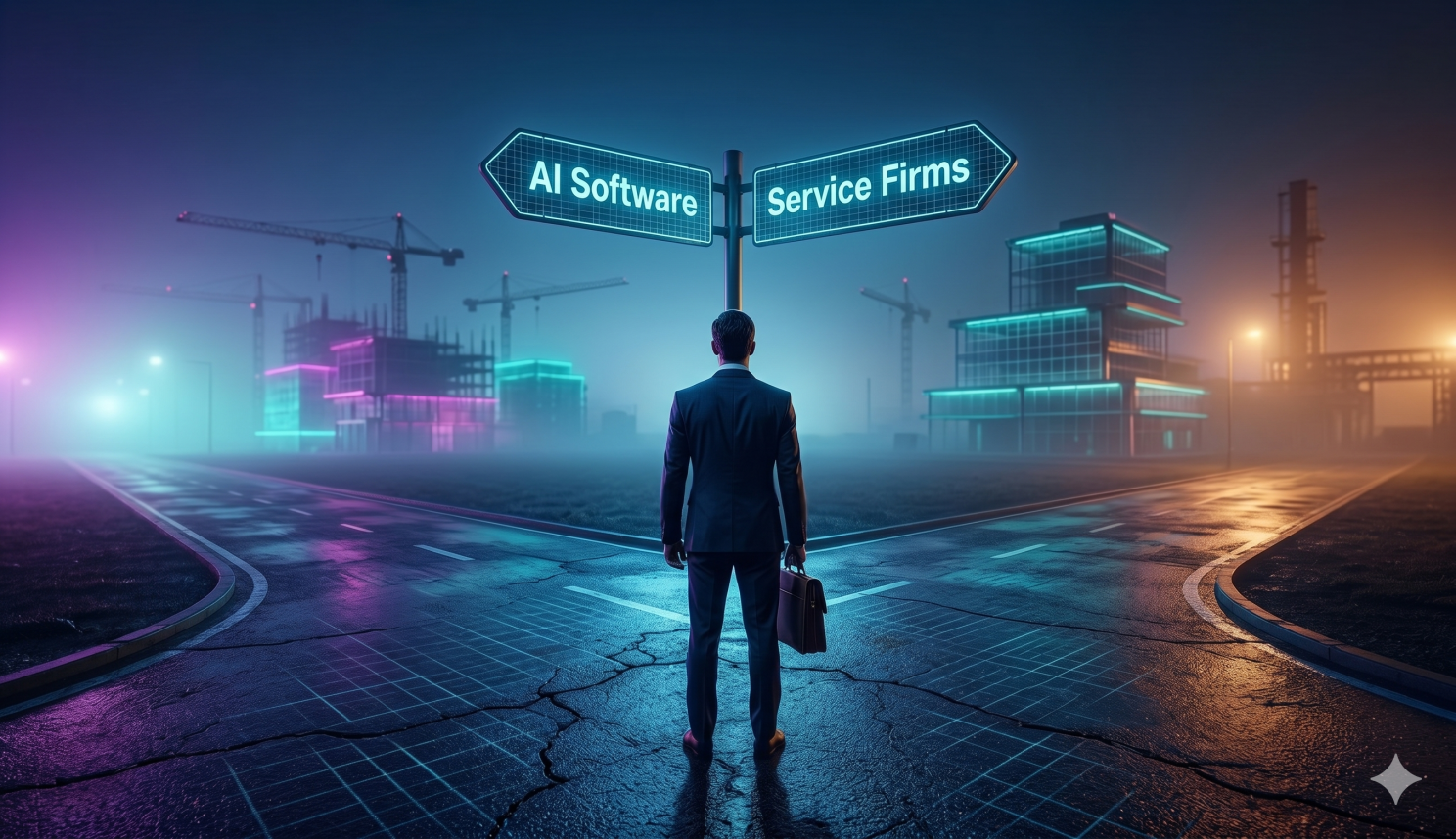
VCs backing AI-powered service firms may accidentally be betting against themselves
There is a tension at the heart of how capital is currently being deployed that Shub and I keep coming back to.
On one side, there are VCs and tech PEs backing software companies whose entire thesis is that AI will automate white collar knowledge work. Legal AI, accounting AI, payroll AI. The promise is that these tools will compress the cost of producing legal documents, financial filings, and compliance work toward zero. That is the product being sold. That is the TAM being addressed.
On the other side, some investors are rolling up the service businesses themselves. Buy the accounting firms. Buy the law firms. Inject AI. Drive gross margins from 50% to 90%. Win the market through efficiency. The logic sounds clean on paper.
Here is what we keep getting stuck on. If the first thesis is correct - if AI really can compress the cost of producing this work to near zero - then the end customer of the service firm will eventually realize they can just do it themselves. Historically, what stopped insourcing was the software development cost. Building a custom accounting workflow used to cost hundreds of thousands of dollars. It made economic sense to pay a fixed cost once and distribute it across many customers through a SaaS product. But if the cost of building that custom workflow collapses to almost nothing - a few hundred dollars, maybe a few thousand - that protection disappears entirely. The moat was always price, not capability.
So if you bought up accounting firms believing AI would make them dramatically more efficient, you may turn out to be exactly right about the technology. But the same technology that makes your acquired firms more efficient is the identical technology that lets your acquired firms' customers bypass them completely. You are betting against your own TAM.
The way Shub and I see it: if we could save $100K a year doing our accounting in-house with AI, we would do it immediately. We would not let our accountant absorb that value. That money stays in the business. And we are not unusual for thinking that way.
There is a version of the rollup thesis that could survive this. Maybe one player consolidates enough of the shrinking TAM to maintain returns even as the market contracts. Maybe the transition window - five years, seven years, ten years while buyers learn to insource - is long enough to generate returns before the floor drops out. But our observation is that most of these bets are not being sized for a shrinking, consolidating market. They are being sized for growth.
Shub also raised something that we thought was worth naming. The business model for AI-ification of services is to sell AI solutions to those same service businesses. Which means your portfolio company is potentially also a customer of another portfolio company. That creates a dynamic worth paying attention to. We have heard stranger things about why certain investments get made. We will leave the details there.
What we keep coming back to is that the two theses - AI will eliminate the cost of producing this work, and we should own the businesses producing this work - cannot both be right at the same time in the same universe. One of them has to give. And our observation is that the examples from just this past week suggest which one it is going to be.
If you want to understand how AEC organizations are currently positioning their data and AI strategy, Speckle is running an anonymous benchmark survey on exactly that. Results will be shared with all participants. Survey: https://survey-eu1.hsforms.com/2aaMXVw5mQvyx9Qy0wEK9Uw2fs1ws

An Insource-Or-Outsource / Make-Or-Buy Decision framework
The shift we are describing is not about AI being perfect, but the cost-benefit calculation changing fast enough that the default answer on a huge range of services is now different from what it was two years ago.
The way we think about it is through three questions you can run on any service relationship right now.
Can being wrong ruin you? If the answer is yes, keep the expert in the loop. Not because AI cannot produce a good output, but because the asymmetry of the downside does not justify the experiment. Health decisions, structural engineering, anything where a low-probability bad outcome is catastrophic - those stay outsourced. If the answer is no, move to the next question.
Is there a physical component that requires presence in the world? If yes, the service is not insourceable regardless of how good the AI gets. If no, you are looking at a pure knowledge work task and you should be asking seriously whether you still need someone else to do it.
Is this a recurring cost line on your P&L that you would notice if it disappeared? If yes, you are probably going to notice it eventually even if you have not looked closely yet. The brands RFP that went from $100K to $10K. The ESOP that went from $20K to $1K. These are not anomalies. They are previews.
If you run a service business, the honest version of this framework tells you something about your own exposure. Which of your services pass all three tests from your customer's perspective? Which ones do not? The ones that do not are the ones where your customer is going to start running the experiment themselves. Maybe not this quarter. Maybe not this year. But the P&L pressure will get there.
The services that survive are the ones where the customer genuinely cannot afford to be wrong, cannot do it physically themselves, or both. Everything else is, in our observation, on a path toward insourcing. The timeline is uncertain. The direction is not.
You Can Find More Analysis On The Practical Nerds Podcast
Spotify: https://open.spotify.com/show/1Q86tEwusNGwAmRdDqjFL4
Apple: https://podcasts.apple.com/de/podcast/practical-nerds/id1689880222
Foundamental: https://www.foundamental.com/
Subscribe to the Newsletter: https://www.linkedin.com/newsletters/practical-nerds-7180899738613882881/
Follow The Practical Nerds
Patric Hellermann: https://www.linkedin.com/in/aecvc/
Shub Bhattacharya: https://www.linkedin.com/in/shubhankar-bhattacharya-a1063a3/
#AIInsourcing #WhiteCollarAI #FutureOfWork #ServiceBusinesses #VentureCapital #AIAutomation #KnowledgeWork #StartupStrategy