
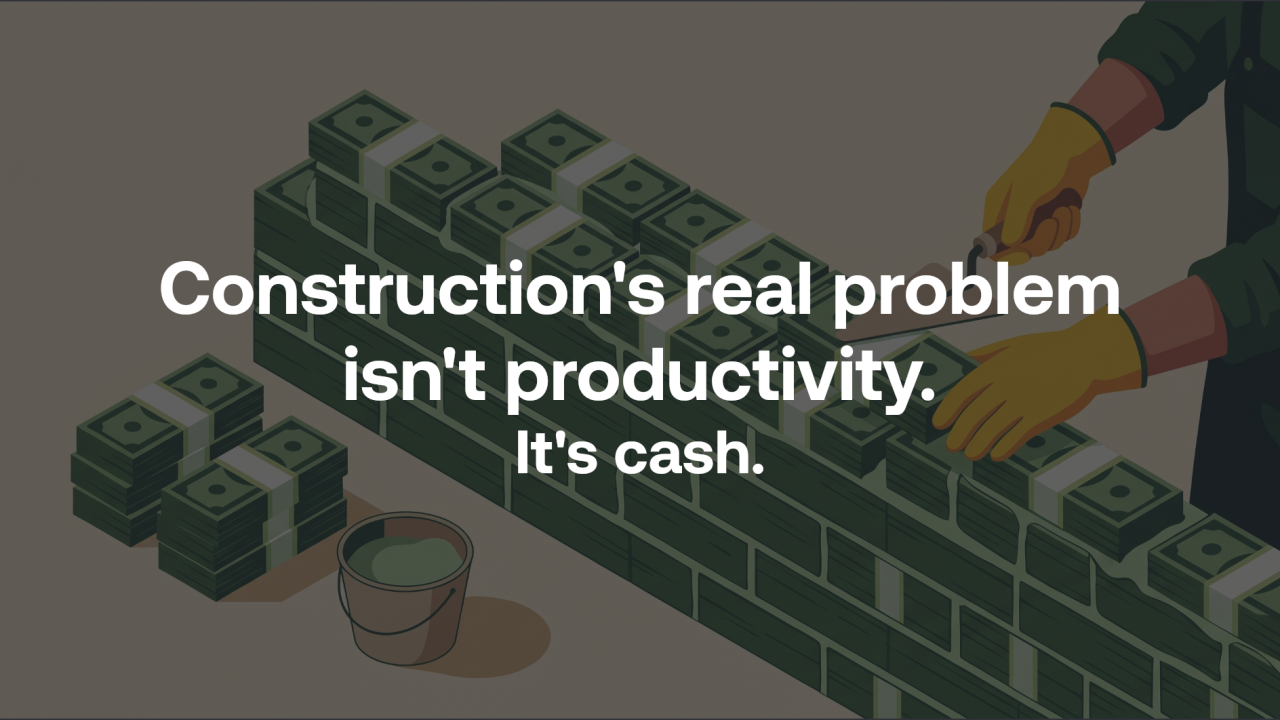

Construction has a productivity problem.
Construction has a labor problem.
Construction has a digitalization problem.
Sure, fine. I've heard this 100s of times. And all of them are true, don’t get me wrong!
For example, McKinsey has been banging the productivity drum since 2017: construction productivity has barely budged in nine years, the sector is one of the least digitized in the entire economy, and closing the gap is supposedly worth on the order of $1.6 trillion a year. Every founder in this space has internalized that framing. So, naturally, through those lenses, entrepreneurs have spun up a ton of software companies over the past decade, tackling the productivity gap: scheduling tools, BIM platforms, field apps, AP automation, take-off software, you name it. Real products, providing real value (with wide variance).
Yes, the industry is inefficient.
But it baffles me that in all this discourse, (almost) everyone seems to walk straight past the one foundational problem sitting underneath all the others. The problem deciding who gets to take the next job and who quietly goes under. The problem nobody wants to touch because it's, well, deeply unsexy.
The problem called capital. Or financing. Or cash.
How come (almost) nobody is talking about this, when it's arguably the biggest problem of them all?!?
You cannot software your way out of a problem whose denominator is cash. A perfectly optimized schedule doesn't help a subcontractor who can't make payroll because his last three invoices are sitting unpaid.
Efficiency assumes liquidity. Construction's problem is that liquidity is exactly what's missing.
Hence, in what is (perhaps) a controversial take, I am going to say this: construction is a financing business wearing a hard hat. Every other problem is secondary to capital.
Let me walk you through what I mean.
Everyone in construction is a lender

Strip construction to its core, and what you're actually looking at is a working-capital machine that doesn't quite work.
Think about the sheer size of it. Something like $10Tn (as in trillion!!) of global output, or roughly 13% of the world economy, runs through this industry every year, and almost none of it gets paid on delivery. It moves on terms. Specifically, long terms: the work happens now, but the money shows up later, in pieces, after inspections, with a chunk held back "just in case". Construction effectively runs on the promise of cash, stretched across weeks and months.
The problem is that the smallest, thinnest-capitalized players at the bottom of the chain (the subcontractors and suppliers) are the ones extending interest-free credit upward to developers and general contractors who are far more creditworthy than they are. The weak finance the strong. Every project is, in a way, a small leveraged deal funded by the people with the least access to leverage.
Alright. Forget the materials flow for a minute. Just watch the dollars and ask one question at each step: who is financing whom?
Let's start at the top. The developer or owner is, fundamentally, a financier with a permit. Strip out the org chart, and what do they actually do? They assemble equity, raise construction debt from a bank, and release it in stages against completed milestones (a process now increasingly run through dedicated software platforms that administer hundreds of billions of dollars of construction lending a year). That's the job. They are not "building" anything in any literal sense, they are just timing and disbursing capital. And they pay slowly, deliberately, because they can. The party at the top of the waterfall sets the tempo, and the tempo is slow.
One rung down, the general contractor's real function is to intermediate risk and timing. In capital terms, the GC exists to absorb the gap between when the owner releases money and when the work (and the people doing it) actually need to be paid. That's an uncomfortable gap to sit on top of, so the GC doesn't sit on it: they push it downstream, using two contractual instruments. The first is retainage, which is the practice of holding back a slice of every single payment (typically 5 to 10%) and not releasing it until the job is substantially complete, which in practice can mean a year or more after the work was done. It's framed as a quality guarantee. In cash terms, it's an interest-free deposit that the sub is forced to leave with the GC. The second is the family of "pay-when-paid" and "pay-if-paid" clauses: "Pay-when-paid" is about timing (the GC will pay the sub once the owner pays the GC), while "Pay-if-paid" is about risk (the GC will pay the sub only if the owner pays, meaning if the owner defaults, the loss flows all the way down to the sub who had nothing to do with it).
Which brings us to the bottom of the stack, where the subcontractor gets crushed. Why? The sub fronts the labor. The sub fronts the materials. And then the sub waits (an average of around 56 days after submitting a payment application, by Billd's most recent reading of the market). If you're going to ask a GC how long they think it takes, they will probably say about 30. But construction routinely runs a 60-to-90-day collection cycle, against roughly 30-45 in manufacturing and software and under 20 in retail. Construction carries the slowest days-sales-outstanding of any industry on earth: it is an industry whose entire structure is late by design.
Step back and look at what we've just walked through. This is a financing structure, hiding in plain sight, wearing the costume of an ordinary supply chain: the contract is the loan agreement, the schedule of values is the repayment schedule, the pay application is a drawdown request, the retainage is a holdback. Money flows down the chain in tranches, slowly, with risk priced in at every layer, and the deeper you go, the heavier the financing burden and the thinner the access to actual capital.
The only reason we don't call any of this "lending" is that the people doing the lending never signed up to be lenders. They thought they were pouring concrete and pulling wire. They are, in fact, running the most thankless bank in the economy.
The paradox: the subcontractor is the bank and the unbanked

One takeaway from what we've just discussed above is the following: the most prolific lender in the system is also its least bankable borrower.
Your electrical contractor, your steel erector, your drywall sub: they can be seen as a credit institution originating a "loan" the moment they show up on site, because they pay for labor and materials today against a promise of money that arrives in 60 to 120 days. The borrower is the general contractor or the developer: a counterparty that is, almost without exception, larger, better capitalized, and more creditworthy than the lender. This is, in every meaningful sense, the worst loan book in the world: 0% APR, involuntary, unsecured, and made to someone who outranks you.
Then it gets worse because of retainage. On top of the 60-to-120-day wait for the bulk of the payment, the sub also surrenders 5 to 10% into a holdback that doesn't come back for another ninety days to a year or more after the work is finished. Now consider this: according to CFMA (Construction Financial Management Association), the typical subcontractor's net margin runs in the mid-single digits, call it 6 to 8%, while retainage is routinely set at 10%, which effectively means that the amount being withheld is larger than the entire profit on the job! A subcontractor wins a $10 million contract -> 10% retainage means $1 million sits in someone else's account, untouchable.
According to a survey from Levelset, a Procore Company, only about one in eight construction businesses said they always get paid on time, and that roughly 40 days into a job, one in five firms has already gone cash-flow negative; more than half of subcontractors reported waiting longer than 60 days just for retainage to be released.
In the UK, the building-engineering trade body found that over a three-year stretch, something like 44% of its contractors had retention money simply erased when a party above them in the chain went insolvent before releasing it (the average hit was around £80k per contractor across their contracts). That money was earned, owed, and gone, because it was sitting in the pocket of a company that failed.
So now flip the lens and look at this same subcontractor the way a bank's credit committee would. What walks through the door? Lumpy, project-driven revenue with no recurring contracts. Customer concentration. An end market that is cyclical. No bank wants that file. So the sub can't get bank credit at a sane price.
And this isn't anecdotal. Bank credit runs around 6% of revenue in construction, against 15-25% in virtually every other industry (quoting FAKTUS here). Put the two facts side by side (the longest payment terms in the economy, the lowest access to bank credit) and you've located the exact spot where financing need is highest, and financing supply is thinnest. Plus, it's not that banks just lend to construction slowly: they're actively backing away. US banks held about $484Bn in acquisition, development, and construction loans at the end of 2024, a figure that fell for four straight quarters, and the regulatory math is part of why: most of these loans carry a 150% risk weight, half again as much capital as an ordinary commercial loan.
Ultimately, subcontractors are a bank without a balance sheet, lending to customers more bankable than they'll ever be, while being told by every actual bank that they themselves are uninvestable. That is the paradox, and it is the entire thesis in a single sentence: the most prolific lender in the system is also its least bankable borrower.
Why good companies die anyway

Here's another paradox: in construction, growth can literally bankrupt you.
In a normal business, winning a bigger contract is unambiguously good news. You sell more, you make more, you bank more. In construction, winning a bigger contract is a moment to start worrying, because a bigger job doesn't pay you sooner, but rather forces you to front more: more materials purchased up front, more labor on payroll every Friday, more retainage locked away, more weeks of float between the work being done and the money arriving.
Additionally, the financing doesn't scale with you. Your backlog might triple, but your bank line (assuming a bank gave you one at all) doesn't triple to match it. Which means that the reward for landing the project of your career is a working-capital gap larger than anything you've survived before, and a longer wait at the bottom of it. The survival data backs the "growth can kill you" point bluntly: barely a third of US construction firms that opened in 2011 were still standing a decade later, well under the cross-industry average.
Now, the conventional wisdom says construction is simply a bad place to lend: too many companies go under, the default rate is ugly, stay out.
As already anticipated, on the surface, the data backs that up.
For example, the UK has now spent four straight years with construction sitting at the very top of its insolvency tables: more company failures than any other sector, year after year, with the most recent twelve-month count running close to 3.8k firms and still meaningfully above where things stood before the pandemic. In India, real estate and construction together account for more than 40% of new cases entering the bankruptcy system. In the U.S., overall business bankruptcies nearly doubled between 2022 and 2024, and construction shows up, predictably, among the hardest-hit verticals every time. Continental Europe tells the same story in different currencies: Allianz Trade clocked construction-sector insolvencies rising across the board into late 2024, with Germany up about 20%, France 31%, Italy and Sweden 35%.
So it's effectively true: construction businesses really do fail at frightening rates. But here's the part everyone stops short of: you have to understand why they fail.
When a credit committee sees a high failure rate, they read it as a quality problem: these must be bad businesses, badly run, in a bad market. And in construction, that reading is mostly wrong. Dig into the failures, and you find that a huge share of the companies that go under were profitable. Roughly half of construction businesses report net margins above 10%, genuinely solid by any standard, and yet only about one in ten say they reliably get paid in full and on time. These firms aren't dying because the business is bad, but because the business model itself forces them to extend more credit than they are capitalized to extend, into an industry where that credit gets paid back slowly, partially, and sometimes not at all. And the data agrees with the framing: a study cited for years by CFMA pins around 82% of small-business failures on cash flow rather than on a bad product or no demand. In construction specifically, research finds north of 80% of contractor failures trace to budgetary and cash-flow trouble, and a rounding error to anything resembling product-market fit. Allianz discovered that a 1% tightening in credit pushes insolvencies up by roughly 3% within three months. Cut the cash and the failures follow on a timer: that's a crystal clear liquidity signal!
All the above means that the "default rate" isn't measuring what lenders think it's measuring: it's not telling you these are bad credits, but that nobody has built the right product to keep good credits liquid.
Which brings us to the obvious objection: if the problem is this clear, why hasn't all the software money already pouring into construction solved it?
Why software hasn't fixed it

"Hold on", you might say. "There's been a tidal wave of capital into construction technology over the last decade. Smart founders, real products, some good outcomes. If financing were the real problem, surely one of them would have solved it by now!".
The reality is that everyone loves to build software. It's sexy. And, from my vantage point, it's also easier than building a construction-focused lender. Significantly easier. Besides, lending in construction is also deeply misunderstood, so why would anyone want to build when they can only face headwinds from equity investors? I understand most founders' perspectives in this regard.
Now, hold your horses: I am not saying software is useless and that no one should build it anymore. Construction software is genuinely useful. And a whole wave of software has been built specifically for construction's financial stack, too, and have provided great value to the industry.
But what do software tools do? They digitize. They automate. They track, reconcile, flag, forecast, streamline.
What do these software tools not do, though? None of them pay.
That's the whole thing. Software optimizes the invoice, that's it. It doesn't pay it. It trims efficiency at the margins while the core problem, the cash that simply isn't there, sits untouched.
Sure, these tools help, don't get me wrong. But a faster pay application is not money in the bank. A flawless lien waiver is not money in the bank. A beautifully reconciled budget-variance report, updated in real time, color-coded, exportable is still not money in the bank. Every one of these is necessary and useful, but not any single one of them is sufficient. You can hand a subcontractor the most elegant accounts-receivable dashboard ever designed, with every outstanding invoice tracked to the day, and on day 56 of waiting for a general contractor to release a payment, that dashboard will not buy a single yard of concrete or make this week's payroll. It will tell them, with great precision, exactly how broke they're about to be, though. How useful!
In a medical metaphor, knowing precisely how sick you are is not the same as being treated, and for years the industry has been pouring capital into ever-better charts letting you know how healthy or sick you are, or about to be, while the treatment is, and always has been, capital. In this context, software becomes the tool through which you see the problem clearly enough to underwrite it.
There's also a reason this is solvable now in a way it wasn't a decade ago. Something like 80 countries are now mandating B2B e-invoicing, and the big construction markets are all in the rollout. Once an invoice is structured, machine-readable, and validated by the tax authority at the moment it's issued, a financing layer can plug straight into it. That said, if you think that regulation alone can fix the cash flow problem, I have bad news for you. The public sector has been trying for twenty-five years and the problem is still here: the UK, Australia, Singapore, New Zealand, and Canada have all written statutory adjudication into construction contracts to force faster payment, and yet here we are, still talking about 56-day waits.
So if capital is the obvious answer, why hasn't the smart money rushed in? Because this is the exact point where most VC investors' eyes glaze over. We've already discussed how, on paper, lending into construction looks like a nightmare you'd cross the street to avoid.
It's.. capital-intensive (duh!): a loan book scales only as fast as you can fund it. Software instead scales on near-zero marginal cost. Every incremental dollar lent is a dollar that has to come from somewhere, and that funding has a cost and generally a limit. You grow by raising more money to lend, which is fundamentally slower and harder than upgrading some seats on your enterprise customers.
Besides, a pure-play lender doesn't get valued like a software business. And lending is also regulated.
So, to be fair, I understand the un-actractivness of this opportunity space for founders and VC alike when the mental model is SaaS. At the same time, I just don't share it: a construction lender, on its own, is really not a bad business to begin with, quite the opposite! Moreover, construction lending does not need to be the end goal. It can simply be the wedge into something much larger. Let's talk about it.
Why I love lending in construction

Now, we've just described why building a lender in construction is hard. And yet this is precisely the part I love. Because all of that difficulty is exactly why the problem is still unsolved, and in my field, an unsolved problem is the rarest, most valuable thing.
Think about where everyone else is building. The hundredth agentic-AI procurement tool. The hundredth contract-review copilot. The hundredth "AI for construction" wrapper. All chasing the same customers, all racing each other to zero margin in a knife-fight of feature parity. Lending is the opposite. It's hard, it's unsexy, it requires a kind of craft that doesn't come from a model API, and so almost nobody does it well. That scarcity is the whole point. If you crack it, you don't fight a gazillion lookalikes, you get to capture an enormous, timeless pool of value with very little competition (if any) standing next to you. The difficulty is the moat, the barrier to entry. The "unsexy" is the alpha, in investors' terms.
So what's the craft?
First, it comes down to knowing whom to lend to. That sounds almost too simple, but it's the whole game, really. I've never said that every subcontractor is a good credit, quite the opposite: some genuinely shouldn't be lent to. Selection matters enormously, and a lender who waves everyone through deserves the losses they'll get. The skill is lending to the right somebody.
So while not everybody is creditworthy, a huge share of the contractors banks reject are not actually risky, they're simply illegible to a bank. The two are completely different things. A generic lender pulls up a subcontractor, sees lumpy revenue, thin equity, and a balance sheet that's mostly aging receivables, sets a 30-day clock, flags everything past it as delinquent, and stamps the file "decline". Of course they do: they're measuring the wrong thing entirely. They're underwriting a borrower when they should be underwriting a payment chain. Look at what a bank actually reads: an invoice, a debtor, a due date, an account balance, and an annual balance sheet that's often two years stale. None of that tells you whether this worksite will pay. To underwrite this properly you have to read something completely different, e.g. the construction contract and its technical clauses, the validated work-completion statements, the surety and guarantee chain, the real execution risk of the sub. Balance sheets say nothing about execution.
Flip the lens and the same "risky" contractor looks completely different. Don't ask: "Is this subcontractor creditworthy?", but rather: "Who actually pays at the end of this project, how good are they for it, and when (in the real world, not the contract) does the cash land?" Underwrite the project and the ultimate payer, not the borrower's balance sheet. Not all payers are equal: a government body or a public authority pays slowly but pays with near-sovereign certainty, an investment-grade developer is almost as good. For payers like these, the question was never if you get paid, only when, which is exactly the question a lender who understands the timeline can price. Also, it's not just who pays but when in the project you lend: finance the early-to-mid stages, when work is ramping and performance is visible, and stay away from the tail end, where a job is 95% done, completion scrutiny is high, and every remaining payment is one dispute away from being frozen. Size the loan to the true payment timeline instead of the fictional contractual one. Validate that the invoice is real and accepted before you advance a cent against it.
Rate all the parties in the chain, not just the one asking for money. Do all that, and a contractor the bank threw on the reject pile reveals himself as a perfectly sound credit: profitable, reliable, simply mismatched to a banking model built for a different kind of business. Well done: you're now collecting the credits the bank was too lazy, or too generalist, to read correctly! (I am clearly oversimplifying here).
This is why the craft compounds, and why it's so hard to copy. Every loan you make teaches the model which signals actually predict trouble and which ones a bank merely assumed predicted trouble. You recalibrate. You get sharper at telling the genuinely untrustworthy apart from the merely unbankable.
Which leaves the obvious objection: fine, but you still have to be the lender. You still need a balance sheet. Doesn't that drag you straight back into the bank-multiple, capital-heavy, balance-sheet heavy trap?
No, if you're not stupid about it. You do need to originate the credit (e.g. receivables, approved pay applications, certified invoices) yourself: that's non-negotiable, because the underwriting is the product and you can't outsource your edge. But you don't warehouse the risk on your own books. You raise the capital off-balance-sheet (e.g. in a securitization vehicle, an SPV), so that institutional senior debt funds the overwhelming majority of every loan, while you hold only a thin junior, first-loss slice. There is a deep, liquid market standing ready to take this risk off your books. Receivables securitization is a multi-trillion-dollar market, with trade-receivables-specific structures alone running into the tens of billions outstanding. You originate, you service, you keep the underwriting take. The heavy capital sits with the institutions whose job is to hold heavy capital. Your exposure stays small and your economics light. And no, this doesn't mean becoming a broker, a loan-channeler passing files to someone else's credit committee: that solves nothing, because the moment the final yes/no sits in another institution's hands, you've given away the only thing that was ever yours. You must be the lender.
But here's the part not to underestimate: raising that institutional debt is a skill in its own right that is a completely different sport from raising equity. As a founder building in this space, you need both, but you'll spend far more of your life raising debt than equity. Equity and debt are two different conversations with two different audiences who want two opposite things to be true. When you raise equity, you're selling the dream, the upside: the enormous market, the vision, the hockey stick, the decacorn valuation. A VC is buying the chance this becomes huge and underwrites the highly probable fact that you're going to zero. A debt provider, on the other hand, could not care less about your dream. In fact, the dream makes them nervous: the senior lender funding 90% of your loan book wants to be bored. They want low and stable non-performing loans, clean cohorts, predictable collections, concentration limits respected, a recovery process that actually recovers, and a track record that says next quarter will look like last quarter or better. You're not selling a vision to these people, you're proving an absence of problems.
And debt raising is progressive: that's what makes it a flywheel and not a one-off. You don't walk in on day one and get a €1Bn facility at a great rate (I know some of you might say there's a recent startup in contech proving the opposite, but that's the exception that proves the rule). You start small and expensive, often with a tiny, pricey trust or warehouse line, because you have no track record and the lender is pricing their ignorance. You season a book. You show them multiple rotations of clean repayment. You let them watch your defaults stay where you said they'd stay through an actual cycle. Then the facility gets bigger and the rate comes down. Then bigger again, and cheaper again. And that falling cost of funds is the whole point, because it widens the gap between what you can charge and what your money costs you: you're lending at rates the subcontractor happily pays because their alternative is rejection from a bank that won't return their call, or a moneylender charging predatory rates, while your blended cost of funds, especially as you build a track record, compresses well below that. The spread between what you can charge and what your capital costs is the engine. Better still, it widens over time: every clean cohort you put through the machine makes institutional capital more comfortable, which lowers your cost of funds, which fattens the spread, which lets you lend more and gather more data, which lowers your cost of funds again. The flywheel compounds in your favour enormously over time. Founders who can run that gauntlet (who can speak credit fluently, structure an SPV, satisfy a risk committee, and keep institutional capital comfortable while they scale) are rare. And that rarity is, again, exactly why the moat is real.
So to recap this opportunity: a hard problem nobody else wants, a misread asset class you can underwrite better than the banks, and a capital-light structure that turns a "boring lender" into a high-margin originator with a widening spread. To me, this is a business to run toward, not avoid!
From lender to operating system

"But you're still just a lender, and lenders get lender multiples", you'll say. Sure. Except you're an asset manager: you earn a spread and fees on billions you don't own, and fee streams on other people's capital command a very different multiple from a bank's loan book. And even setting that aside, I'd happily back or own a multi-billion-dollar book throwing off a widening spread. But here's the thing: it doesn't have to stop there.
Lending is, or can be, the wedge: it need not be the destination.
As a matter of fact, an uncomfortable truth is that lending, on its own, is not inherently sticky. A subcontractor running on thin margins will move for a rate 100 or 200 basis points cheaper, and no amount of goodwill will stop them. Service and trust buy you a little loyalty, but not much: money is fungible, and a discounted invoice is a discounted invoice at the end of the day. So if all you ever sell is financing, the risk is that you've built something that can be undercut the moment a better-funded competitor decides to.
You start with financing: invoice advances, materials financing at the point of procurement. And once you're the one keeping a contractor liquid, you've earned something more valuable than the interest: you're now sitting inside their financial life, the first place they turn when they need money to move. From there, the question becomes "What else does this customer need that I'm now uniquely positioned to give them?". Once you ask it that way, the answers come quickly. Surety and bonding, a multitude of insurance products, leasing, payment cards, and more. You might even end up building software for them (e.g. project management, job costing, whatever) partly to make their life easier and partly because every workflow you host feeds you more of the data that prices everything else. Each new product runs off the same underwriting data, the same relationship, at almost no incremental cost to acquire, because you already won the customer with that first advance.
Put all this together within a stacked product suite, and you get the thing that actually matters: entrenchment. Once a contractor runs their financing, their account, their cards, their bonding, and their insurance through you, leaving isn't a matter of finding a cheaper factoring rate. Leaving means ripping out and reassembling their entire financial back office across a dozen disconnected providers, none of whom understand their projects. Nobody does that to save a few basis points. The switching cost compounds with every product they adopt, and so does your share of their financial life. You stop being a vendor they can swap and become infrastructure they're built on. And the same underwriting engine that prices the subcontractor doesn't only point down at them: it points up the chain at their suppliers and down it at the general contractors who hire them - there is a ton of optionality you can explore here.
Moreover, eventually, the data stops being just an input and becomes a product in its own right. Once you hold the most complete record of who-pays-whom-and-when in an entire market, you're sitting on something a Dun & Bradstreet would recognize: counterparty-risk intelligence that insurers, main contractors running vendor diligence, and developers managing exposure will all pay for. The paradigm changes from "we underwrite better than anyone" to "we are the credit bureau for this industry".
And notice what's happened to the story along the way. You started as a "lender" (the thing that supposedly gets a lender multiple) and somewhere in the stacking you stopped being one. You're now the account a contractor runs their business through, the underwriter of the insurance and financial products they buy, and the definitive data layer on who pays whom in an entire industry. You've become infrastructure and/or a vertical neobank. And with this change in narrative comes the change in multiple. That's a much better story, right?
If you want an example of an exceptional company taking advantage of this opportunity the right way, go check out our portfolio company FAKTUS (which we can proudly say we've backed since day 0!).
Ultimately, one reason this opportunity excites me is the size of the prize. Remember what the addressable market actually is here. This isn't one of those software TAMs you reverse-engineer from a per-seat price times a generously rounded number of seats, the kind that evaporates the moment anyone pokes at it. The denominator here is construction spend itself. The financing need sits on top of trillions of dollars of work that all moves on credit, which means the realistically serviceable slice of it is plausibly the largest of any opportunity in the entire construction-tech landscape. And the second reason is the flip side of the first: a prize this size is almost always swarmed with competition. This one isn't. It sits largely unaddressed, behind high barriers to entry, with switching costs that compound with every product a customer adopts. The difficulty that keeps everyone else out is the same thing that protects you once you're in. Big and defensible rarely travel together. Here they do. Gotta love it!!
Alright, it's time to bring this home.
Conclusions

So let me bring it back to where we started.
Construction has a cash problem. Every other symptom, the inefficiency, the failures, the firms that quietly go under in a good year with a full order book, traces back to the same thing: an entire industry running on credit extended by exactly the people least able to extend it.
Where everyone else sees a bad place to lend, the structure actually hides a misread asset class, a generation of profitable, reliable contractors thrown on the reject pile not because they're risky but because they're illegible to a banking model built for a different kind of business. This structure actually hides a misread asset class and a path from a single financing product to the infrastructure/neobank play. And here's the part that makes me lean all the way in: it's almost completely unaddressed. A market this size is normally swarmed. This one isn't, because the difficulty that scares everyone off is the same difficulty that keeps the field empty and the moat deep. Big, defensible, and wide open at the same time is a combination you almost never get to see, let alone back.
This is unsexy. It's hard. It requires craft that doesn't come from a model API, and patience that most founders and most investors don't have. Which is exactly why I love it, and exactly why whoever gets it right won't have much company standing next to them.
If you're a founder taking a real swing at construction's capital problem, or building anything else in infrastructure and the project economy, come talk to us at Foundamental. The unsexy, structural businesses everyone else walks past are exactly the ones we want to back early!
More appetite for this type of content?
Subscribe to my newsletter for more "real-world" startups and industry insights - I post monthly!
Head to Foundamental's website, and check our "Perspectives" for more videos, podcasts, and articles on anything real-world and AEC.
#ConstructionTech #EmbeddedFinance #ConstructionFinance #ProjectEconomy #FinTech #VentureCapital #WorkingCapital #Contech