


As my time as an investor progresses, I started getting more and more exposed to the Arrival story, some of its former employees and started thinking about it as a small “mafia”. Although, this term is usually associated with former employees of successful companies (or southern Italian powerful organizations), Arrival tried to be so disruptive that they deserve that adjective (scroll for the cool video).
Put simply, I always filed Arrival under one line: microfactories don’t work, speaking with Jamie I realized there’s more to that, and again (like for Katerra) the culture matters (a lot).
Jamie’s uncommon background
- He didn’t go to uni and and started as apprentice toolmaker (press tools, then injection molds), followed by 5 years as a CNC machinist, making complex prismatic parts for aerospace, defense, oil and gas, automotive and medical
- Then went to university to study Engineering Product Design in London, after that joining McLaren Automotive as a design engineer working on how their road cars get built
- Joined Arrival in 2016 when it was about a year old. After an initial period working on the early concept electric van, he designed an electric last-mile delivery bike, then spent around five years leading mechanical design for a mobile robot platform for the microfactory
- He then took robotics at heart and joined Recycleye (AI waste-sorting robots, which got acquired by CP Group in 2026) to commercialise their hardware products
- now with over 20 years experience decided to independently run a design engineering practice for robotics, automotive, drones, medical, energy, consumer goods and logistics transport (Design 3D Services)
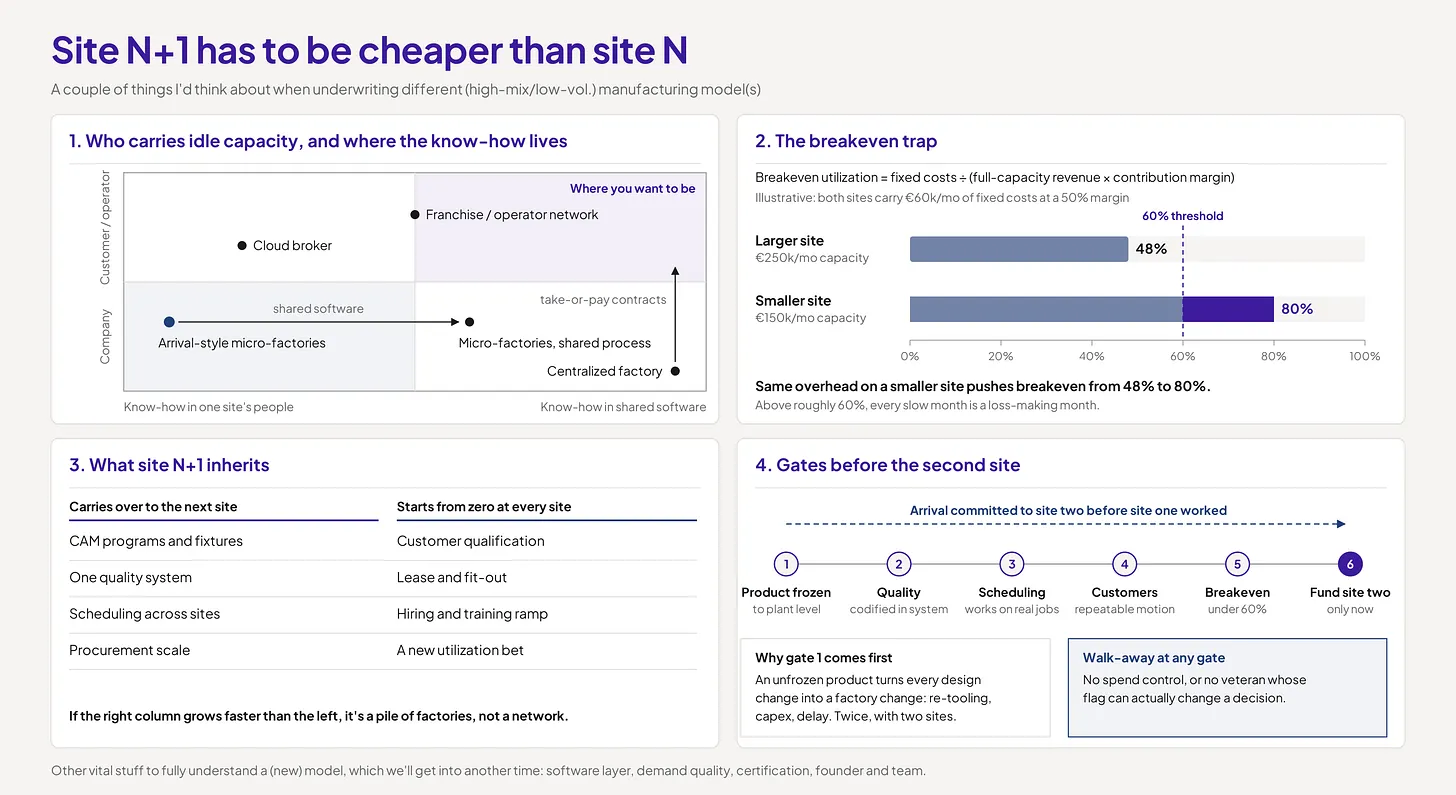
To get into the topic, I find it useful to share a quick framework to assess what’s relevant in various manufacturing models I’ve seen(eg micro-factories, franchising, cloud manufacturing, roll-up etc) - at least, this is how I think about what the riskiest assumptions in the space are.
Jacopo: McLaren is generational, institutional discipline: patient capital, extreme engineering quality, low volume. Arrival promised to break legacy automotive economics with microfactories. Those are about as opposite as capital postures get in hardware. What changed in the engineering practice on your first day?
Jamie: You have to know what Arrival was a year before I joined. The plan was to electrify existing vehicles: EV powertrains retrofitted to a Sprinter, a Transit, or a lorry for example. Batteries, motors, sensing, ADAS, all developed and tested on donor vehicles. However, it was proving difficult to work with OEMs. Unsurprisingly, companies like Mercedes, Ford or Iveco did not want to open up or share their proprietary vehicle data to a company of about 50 people nobody had ever heard of. It wasn’t even called Arrival yet.
So they pivoted. They thought:“No one wants to sell them to us, then we’re going to make our own.” That’s when they started hiring people like me, from engineering and automotive manufacturing and it was a true blank sheet. The mentality was to start from the ground up, challenge absolutely everything, and always remind yourself of what the dream was. So only a few people working on designing an entire vehicle from scratch in the early days. That’s what blew my mind the most.
Jacopo: What’s one thing you saw at Arrival that would have been impossible at McLaren?
Jamie: The team. Arrival also hired non-automotive people on purpose, to be disruptive. Engineers from the fashion industry, from aerospace, from medical. It was an incredible team, with a broad scope each person carried.
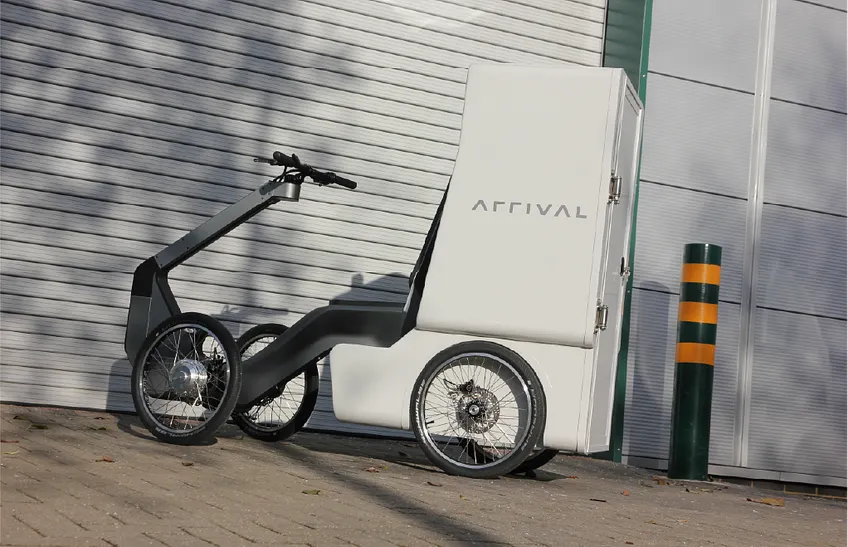
My first big project was a delivery cargo e-bike, from nothing to functioning prototype, ready in time for a wider company investor demo day, with three of us: me, an industrial designer and an electronics engineer. At McLaren you’d be in a team of specialist engineers on one particular area of a car.
Jacopo: So what was the number one bottleneck with that model?
Jamie: Probably the underestimation of how challenging it is to build a production vehicle from scratch. We could get concepts into 3D CAD and into models very quickly. But because you had license to challenge everything, all sorts of rules were being broken. And some of these rules aren’t really that breakable in practice.
You can disrupt the van but you can’t disrupt the crash
Jacopo: Give me the clearest example of a rule that wasn’t breakable - something any McLaren engineer would have known on day one, and Arrival had to learn the expensive way.
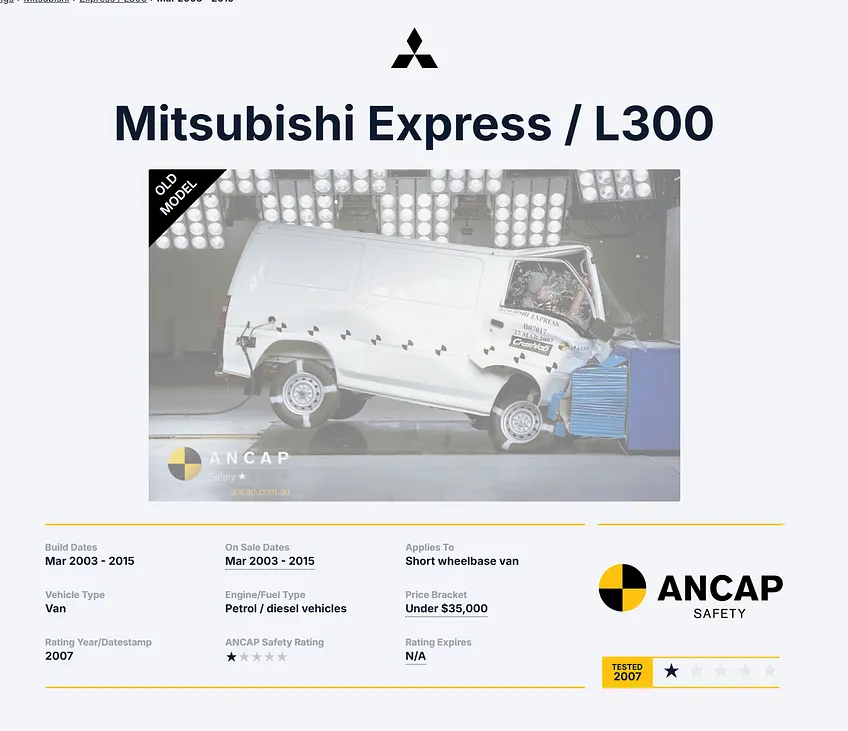
Jamie: Occupant safety was a big one. There are very well defined vehicle crash requirements and guidelines around protecting the person in the vehicle. With certain classes of commercial vehicle, you don’t necessarily have to meet the highest ones, although you should, morally. So even if there’s a way to build it, that doesn’t mean anyone is going to buy it. This is something Arrival probably learnt the long way on the early van design.
A lot of the vehicle architecture decisions were based on what looked really good, what looked cool, and what was disruptive. But positioning a driver at the very front end of a vehicle on the road is profoundly dangerous. It would never have scored well a crash test, and legally, for that class of van, it didn’t have to achieve 5 stars. People with automotive experience raised that flag. Yet, Arrival kept challenging and carried on down a path that was technically difficult.
Jacopo: Until the customer asked.
Jamie: Exactly. Some fleet operators who were potential early customers asked about crash safety. I think it was difficult to defend the driver position being where it was in the early van design. It looked cool, maybe on paper it was cost-effective, but no one wanted their drivers at risk.
Also, part of it was the long-term vision. Arrival always worked towards vehicles being driverless, maybe ten years out, so the occupant was a secondary thing, a bit annoying because you have to deal with it for now. We’re starting to see robotaxis today, in some specific and controlled regions, but full level 5 autonomy everywhere seems a long way off. And there’s so much legislation around an occupant in a vehicle. I think maybe that should have carried more weight from the start.
If you track the public updates, the van went from a cute-looking alpha to a super regular-looking van. There’s a reason vans look like that. “You can’t change the legislation, you can’t change the physics.” If you crash at a certain speed with a certain mass, a certain amount of damage happens.
Jacopo: So the tacit knowledge was in the building. Did it have a vote?
Jamie: Not really early enough. That pivot cost Arrival a lot of time and money, and in hindsight I’m sure they wish they hadn’t done it. But that was the point. They wanted to challenge absolutely everything.
A factory is not a data center
Jacopo: Walk me through the moment you first realized microfactories weren’t going to work the way the pitch said they would.
Jamie: I was skeptical straight away, I’d previously seen a lot of assembly production work really well in a ‘normal’ sequential process. I wouldn’t say microfactories can’t work, just more was the right application for one? I wasn’t sure they could work cost-effectively enough to be commercially viable for vehicles at scale. And the microfactory was never the mission in the first place. It came along with the vehicle’s development.
When I joined, the concept was a super simple boxy / flat sided low cost van, built by hand in a factory in Oxfordshire. Build it in something like six hours, swap parts like a Lego set, nothing overly complicated, highly modular. As the van morphed towards a more ‘automotive’ vehicle, it became clear that wasn’t the most scalable way of doing it. Meanwhile Arrival was getting more and more interested in robotics, and around 2018 or so a robotic approach was decided. So, an additional disruptive mission was declared: we build vehicles with robotic assembly and decentralized factories.
Jacopo: Which is where pitch-deck physics and factory-floor physics part ways, at least depending on the customers and the manufactured output!
Jamie: There’s a good reason a lot of high volume producers build something in one central facility and ship it out from there. Consistency, quality, and all processes under one roof maintained. How do you get what people and robots are doing in Oxfordshire carbon-copied in Australia, or in an economic zone in Asia? Making those absolutely identical at scale is really difficult. Plus, it’s really expensive to stand up a factory: CapEx, lease, tooling, machines, talent and training (+ quality and inspection infrastructure). Doing it in multiple places means you keep paying for copies of all of it.
Jacopo: (Non-revenue-generating) fixed cost that don’t linearly scale with revenue-generating assets?
Jamie: Exactly. It’s doable, but it’s a lot of money and a lot of time and effort. There are real benefits, such as local production close to demand, more flexible supply chains, and resilience. It’s like data centers: if one or two go down, the others carry the load - great. But to super oversimplify, a data center is a bunch of compute and network in a protected, cooled building. Not much physical happens there in terms of goods in, processes, logistics, goods out. Building a vehicle is “slightly” more complex, hence more stuff can drift.
Then there’s what happens inside the factory when you mix industrial robots and people. There’s so much compliance around it, so people don’t get injured by a robot or run over by something. Robots move from people zones into non-people zones and back out again. In people zones they have to go much slower at ‘safe speed’. You can’t just run everything at safe speed, because it’s far too slow overall. So everything has to switch state compliantly, and it has to be fail-safe: a sensor breaks, somebody opens something they shouldn’t etc it stops. Getting a factory like that compliant is possible, it’s feasible, but it’s not trivial.
Neither reading is right: the van and the factory were both moving
Jacopo: There are two readings of Arrival. One: microfactories didn’t work. Two: they could have, with a different capital posture. Which do you hold? Or was it that the product they wanted to build never matched the manufacturing philosophy?
Jamie: Start with the money. Arrival was building two microfactories, one in Oxfordshire and one in America. The Oxfordshire one was more mature, but not finished. The US one was maybe six to twelve months into being stood up. When Arrival started to hurt, they stopped the one in America and focused on the UK. A factory is so expensive to stand up that starting a second one before you’ve finished the first, before you know everything, was just too much. And no microfactory ever really started. The UK one probably still needed another year to actually output product efficiently at scale. So, with more time and money I think they could have eventually got online.
Jacopo: That’s insane.
Jamie: The microfactory itself got complicated. Part robotic, part human. The long-term vision was autonomous factories with minimal people in them, but again, maybe a ten-year vision. Everyone knew version one would need people and machines, and even that was difficult enough. I think because the vehicle had become more complex, the factory therefore became complex.
On top of that, you’re building a vehicle that isn’t truly finished. It was probably still one iteration away from being commercially viable. The vehicles could be built, but at a high cost; in BoM parts and labour time. The next step, making them cost-effective to build, meant more investment in scale; hard tooling, production-level fixtures and jigs, production quantities etc. Millions of pounds. I think that’s what stopped the US Microfactory. Why would you stand it up twice when you haven’t proven it once? If you make changes, you have to do it all again.
So it’s a perfect storm. The vehicle is being refined. If the vehicle changes, the factory has to change.The factory is complex to begin with, and you’re planning more of them in parallel before any of that complexity has been simplified. That’s what I mean when I say they underestimated how damn hard it is to build a production vehicle at scale, from scratch.
Jacopo: So the honest answer is the third reading.
Jamie: Pretty much. And to be fair to the model, it is possible. You just have to keep duplicating everything: equipment, training, all of it. The question is whether it’s worth it. What gain do you get from decentralizing, and are you better off overall? Maybe there’s a middle ground, decentralized to a point. Like large automakers: something in North America, something in Asia, two or three sites around the world rather than dozens. That’s much easier to control.
“Why would you stand it up twice when you haven’t proven it once?”
The red flag is nobody with scar tissue in the room
Jacopo: What manufacturing pitches are you seeing today that rhyme with Arrival? And what’s the one thing on a pitch deck that makes you walk away?
Jamie: The pitch I walk away from is the one with little to no expertise holding the purse strings. When I joined, there was only a little automotive experience in the company, which challenged me. I understood the logic after a while: they wanted to be disruptive and challenge everything, and it was essentially one person’s money backing that choice initially. Fair enough. What was hard to get used to was how fast that money was burning, with little financial control early on. By then I’d spent about 15 years in industry, some of it inside big corporates, and I had never seen anything like it.
There seemed to be a lot of high spending in the earlier days; experimental projects, niche equipment, lots of hiring and leases on property - medium to long term financial commitments. Most of that spending was genuinely constructive, it was exciting to see so many projects and research topics, but some of it wasn’t. Over time it seemed to normalise a bit, I don’t think many asked themselves whether they’d spend that money as if it were their own money and question the value add.
Arrival did eventually bring in executives and financial control to get it managed, but by then I think it was too late and the company had already signed huge contracts and supply agreements it struggled to untangle itself from later. In hindsight, I wish I’d fought harder for budget control. So the warning flag for me is the importance of experienced oversight, both on the finances and on the engineering.
Jacopo: Let’s bring it to today. There’s a European new-age manufacturing business scaling through a network of smaller, distributed machine shops instead of one big factory. To me that’s the closest rhyme to Arrival out there right now. How do you read it?
Jamie: It’s a fascinating story so far, and I’m genuinely curious to see if it’s going to take off at scale. A lot of people ask me about it. My skepticism is about quality. Again, a decentralized network producing complex items has to somehow maintain consistent and repeatable quality which is challenging on non-trivial aerospace and defense components - exactly the kind of parts I used to machine. Modern CNC machines and programming software is very good now, however a complex part still needs a solid machining and holding strategy so it comes out right first time - usually experience is critical here. With tricky parts, “everything is fine until it isn’t,” and the moment it isn’t, the part is scrap. In aerospace, defense, medical and nuclear that can hurt even more, because sometimes the material is specific stock free-issued to you, for traceability. If you scrap it, you can’t just always order another billet.
Jacopo: You can’t just run it again.
Jamie: Not always no. The other side of it is the workforce. It’s genuinely amazing to see young people coming into the industry with excitement and energy for it. People in their twenties trained up as machinists or factory managers, and given the ageing machinist workforce, that’s truly needed. I think similarly to what we were discussing earlier; you need that experienced engineering oversight to provide the insight to successfully make difficult parts at scale.
Jacopo: I’d push back a little. The founder doesn’t have to be the best machinist on the floor. My test is simple. If a CNC misbehaves, can you, as the boss, come down, read the G-code and help me de-fuck that machine? If not, can you be the best hiring manager in the industry and hire the people who can? A strong commercial founder can win on the second. Where I’m with you is quality consistency across sites. That’s the hard part, and it’s why I find wholly owned networks of factories with one central quality function more convincing than looser models.
Jamie: It’s possible, for sure, but it’s expensive. Every new site means investing again in equipment, training and everything around it. Before you’ve cut any metal for a client, you’ve signed a lease that often runs ten years, you’re making repayments on the machines, and you’re paying for programming software licenses. My guess is it’ll cost a lot to get going, hopefully there is enough consistent demand to keep those spindles turning - good luck!
Thanks to Jamie for always being so open and available. Easily one of the most interesting profiles in engineering design out there
If you’re an operator or investor working in this space and want to be a guest, hit reply.
thx Claude.