


In the last piece, Adoption beats specs, I argued that adoption is the single metric that cannot be faked on a construction site. LOIs or pilots prove nothing to me, neither do purchase orders (besides providing a testing ground). Only the boot-on-mud reality of whether a worker reaches for the tool the next morning counts.
This piece picks up where that one stopped.
I don’t see adoption (only) as a logistical problem, but more as a psychological event. Work orders, procurement cycles, and integration specs matter far less than what gets used on the jobsite. What decides it is what happens in the worker’s head in the first ten seconds of contact.
As models get more capable (eg voice AI) and a new wave of physical hardware (eg exoskeletons, smart PPE, computer-vision helmets, robotic arms) is leaving production for the foreman’s pickup, the choke points will become progressively more evident. But none of that lands if what the device asks of the worker collides with what the worker expects, needs, and trusts.
(Theory) Framework
I went back to “ancient” literature to find four pieces of consumer psychology to build the vocabulary (ontology is over-used today) for what happens on site, and each one changes what counts as evidence of adoption. The theory is tidy and the ground is not, so here is each frame set against what it looks like in the mud:
1. Rogers’ diffusion of innovations (1962). Rogers argued that whether a new tool spreads comes down to five attributes the adopter perceives in it: relative advantage over what they already use, compatibility with how they already work, complexity or the lack of it, observability of the result, and trialability without commitment. Dearing (2009) later found that relative advantage, simplicity and compatibility with existing norms account for most of the variance. In a time-pressured trade two of them dominate, compatibility and complexity, and together they pose the question: where does the tool fit in the worker’s kit and workflow?
→ On a real site that compatibility isn’t an abstract attribute, but it’s an actual van. A worker inherits the vehicle from whoever held the role before him, and with it a closed system of chargers, batteries and tool bodies all tied to one brand. So he keeps running whatever was already there: once you are committed to one ecosystem there is no real reason to switch to another whose chargers and batteries don’t fit the ones you already own (the same logic that keeps you buying iPhones). The constraint is physical as much as psychological, because the van only has so much space and every new tool has to earn its place in it. The first question for a new entrant is therefore not whether the tool is better, but whether it fits the kit that’s already in the van, and cross-compatibility is the price of entry.
2. The Fogg behavior model (B = MAP). Fogg’s claim is that a behavior happens only when three things line up at the same instant: motivation, ability and a prompt. Remove one and nothing happens. The non-obvious part, and the useful one, is that raising ability, making the action easier, is almost always more reliable than raising motivation, so the practical lever is friction reduction, not safety lectures and not incentive campaigns. The question: what does the tool demand of the worker?
→ On the jobsite this becomes the no-manual rule. A worker picks a device up, turns it over, and expects to figure out how it works on his own, because there is no world in which he spends two hours reading a manual. Proximity is the same filter applied to mandatory gear - PPE goes unused all the time because it’s sitting in a car parked fifty meters away, so the mandate exists but the ability doesn’t.
3. Deci and Ryan’s self-determination theory (SDT, 1985/2000). People carry three innate needs at all times: autonomy (I chose this), competence (I’m good at this) and relatedness (I belong here, with these people). Threaten any one of them with a new tool and the response isn’t negotiation, it’s withdrawal. A device that makes a worker feel watched, deskilled or cut out of his crew gets rejected even when its objective utility is high. The question: how does the tool make the worker feel?
→ On site this shows up most clearly in the surveillance research. Nnaji et al. (2021) found that roughly two-thirds of workers who had used a wearable were willing to share physiological data, and yet the same workers pushed back hard against location tracking. Sum, Shi and Fox (2025) recorded workers calling tracking apps a losing game, and poor management that ignores worker burnout and safety. What they’re really saying is that being located reads as a sign management doesn’t trust them, which is a relatedness wound as much as an autonomy one.
4. Brehm’s psychological reactance (1966). When people feel their freedom of choice is being restricted, they push back to reclaim it, and the push is proportional to the threat. That is why mandates so often produce the opposite of the intended behavior, and why coercion through policy predicts non-compliance far more reliably than acceptance through inclusion. The question: what does the mandate look like?
→ Al-Bayati et al. (2023) ranked the top drivers of PPE non-compliance among construction workers, and the leaders weren’t comfort or cost. They were poor risk perception, lack of safety training and lack of management support. Spector (2022) makes the workplace version sharper: when people feel compelled, reactance kicks in, and inclusion beats coercion. So what is really at stake is identity - a mandate tells the worker that his judgement doesn’t count, and he moves to protect it, which matters all the more in a trade where professional judgement is worth a great deal.
One force sharpens all four of these: Kahneman and Tversky’s loss aversion. A loss of autonomy is felt about twice as heavily as an equivalent gain in safety, which is why a worker can quite rationally turn down a tool that, on paper, protects him. That makes the safety frame, the one most builders reach for first, the weakest pitch you can aim at a worker. Between the two arguments a worker still weighs safety more than productivity, while for the contractor the real lever is time and schedule. What I’d do then is pick the audience first, then the frame, and only then work out how the device fits both.
(Design) Framework
The frames and the site evidence converge on eight constraints, driving the design framework:
- Replace something already worn (do not add to it)
- The van and the worker’s body are already full. Every new device displaces an existing one or it does not get carried. For instance, an ear-protection-plus-communication device works because it replaces a piece of mandatory PPE with a more useful version of the same thing. On the other hand, a device that adds weight without removing weight is a productivity penalty.
- Be self-explanatory in ten seconds
- Evidence points at workers will not read manuals. If the function is not legible from the form, the device dies on the bench. Build the interface so a tired worker at 6 a.m. picks it up, uses it correctly, and never opens an instruction PDF.
- Win the van before you win the worker
- Brand loyalty in this market is kit loyalty. Chargers, batteries, and tool bodies must be cross-compatible, or the entrant is locked out of the limited physical space in the vehicle. A single product without a kit story isn’t generally smart to get.
- Frame for the audience (rather than the pitch deck)
- The contractor cares about time and schedule, while the worker cares about safety and practicality. Build two pitches and two surfaces of the product, because the people writing the cheque and the people using the tool weigh different things.
- Avoid location tracking unless tracking is the product itself
- Workers will share physiological data more readily than location data, because location is read as a management surveillance signal. If the device must locate, make the location data visible to the worker first and to management only with consent.
- Earn the rollout, do not mandate it
- The rollout that wins is the one a worker volunteers into, sees their peer use, and asks to receive (they need to either crave it or feel left behind) - inclusion beats compulsion should be the product’s mantra.
- Make the device fail open, not closed
- If the battery dies or the network drops, the worker must still be able to do the job. A device that fails closed - choosing data continuity over work continuity - is read as the company’s interest overriding the worker’s, which is the SDT autonomy violation cast in failure mode. The potentially direct consequence is loss of trust (which in this market is lost brand capital).
- Earn premium pricing through durability
- Let me point you to Muff saws, where workers willingly pay two to three times for a reputation of reliability. When gear is uncomfortable or unreliable, it becomes a barrier rather than a benefit; when it is trusted, adoption follows organically. Long term reputations on a jobsite are earned at the speed of broken parts - marketing and speed of campaigns’ results are usually short-lived
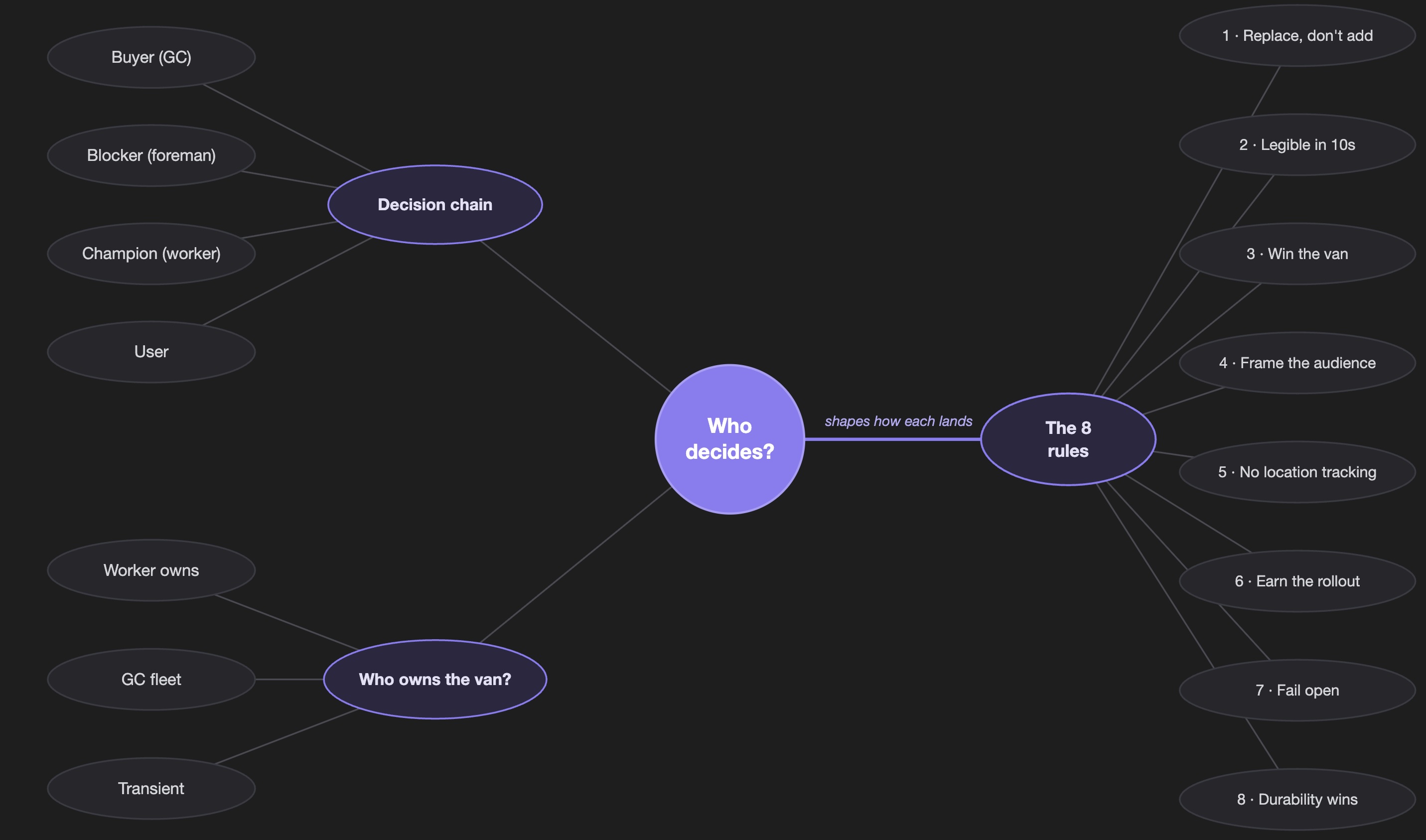
Who decides, and what actually works
If you speak with anyone working in construction you quickly come to understand how many decision nodes there are. The buyer is the contractor or GC, the blocker is the foreman who has seen three failed pilots, the champion is the experienced worker whose van the tool has to fit inside, and the user might be none of them. So before any of the four frames tells you anything useful, you have to answer a blunter question first: who are you actually selling to, and who has to live with the thing once it’s bought? The moment those are two different people, the psychology splits, and the four theories stop applying evenly - and it only becomes a game of how to weight them efficiently.
When a worker owns his van and buys his own kit, the buyer and the user are the same person, and all four frames land on him at once - compatibility is his ecosystem, ability is his ten seconds, autonomy and reactance are his to feel. Change who owns the van and the frames come apart. If the GC owns it and stocks it, the buyer is procurement and the compatibility-and-complexity question moves into their head, while autonomy, relatedness and reactance stay with the worker who gets handed a kit he never chose. The sale turns true B2B, but the adoption test stays exactly where it was: in the worker’s hands the next morning. And for the transient labor pool - bused in, handed whatever is in the crib that shift, easy to replace - there is no van to win at all. For them loss aversion is not about autonomy but about the job itself, as you don’t refuse openly when you are that replaceable (this only applies to generalizable trades, skilled workers are well aware of their bargaining power recently).
How do I distribute my product? Region-by-region motion seems a credible path: win the foreman in one Bauhof and let the next one ask. Distribution here is a social object before it is a logistical one - but that only holds when the worker is the buyer. Sell into the GC’s fleet and those procurement sales won’t necessarily fall for this.
The payoff of scoping the buyer is that you can call a solution before a single unit ships. Run a few common archetypes through the four frames and the eight rules, split by who actually pays:
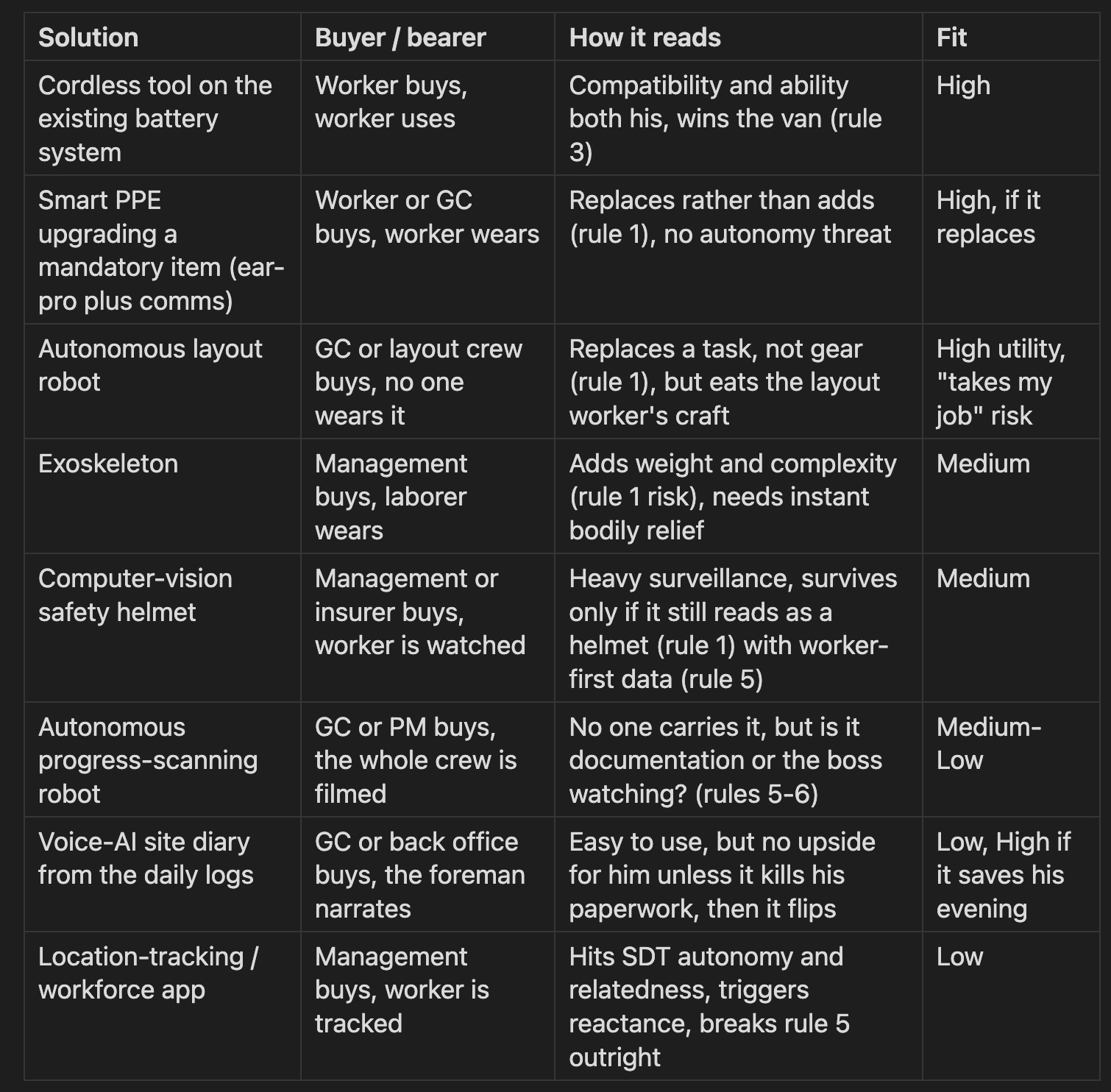
A solution works when the buyer and the user want the same thing, or when it’s built so the user’s frames survive even though management signed the cheque. It fails when the two diverge and the design forgets the person who has to wear it: the purchase closes, but the adoption doesn’t. Bear in mind the table above only shows fit based on (potential) adoption, and does not necessarily constitute my excitement for the opportunity space.
You can find the LinkedIn post here and Substack article here.
(Quick) Sources
- Rogers, E. M. - Diffusion of Innovations (1962). https://en.wikipedia.org/wiki/Diffusion_of_innovations
- Dearing, J. W. - “Applying Diffusion of Innovation Theory to Intervention Development” (2009), PMC. https://pmc.ncbi.nlm.nih.gov/articles/PMC2957672/
- Fogg, B. J. - Fogg Behavior Model (B = MAP), official site. https://www.behaviormodel.org
- The Behavioral Scientist - “Fogg Behavior Model” analysis including limitations. https://www.thebehavioralscientist.com/articles/fogg-behavior-model
- Deci, E. L. & Ryan, R. M. - Self-Determination Theory overview, SDT.org. https://selfdeterminationtheory.org/theory/
- Brehm, J. W. - Psychological Reactance Theory (1966), via The Decision Lab. https://thedecisionlab.com/reference-guide/psychology/reactance-theory
- Spector, P. - “Psychological Reactance Is the Enemy of Change” (2022). https://paulspector.com/psychological-reactance-is-the-enemy-of-change/
- Nnaji, C., Awolusi, I., Park, J. & Albert, A. - “Wearable Sensing Devices: Towards the Development of a Personalized System for Construction Safety and Health Risk Mitigation” (2021), Sensors / PMC. https://pmc.ncbi.nlm.nih.gov/articles/PMC7864037/
- Sum, C. Y., Shi, J. & Fox, S. - “It’s Always a Losing Game: How Workers Understand and Resist Surveillance Technologies on the Job” (2025), ACM CSCW. https://arxiv.org/html/2412.06945v1
- Al-Bayati, A. J., Rener, A. T., Listello, M. P. & Mohamed, M. - “PPE Non-Compliance Among Construction Workers: An Assessment of Contributing Factors Utilizing Fuzzy Theory” (2023), Journal of Safety Research. https://pubmed.ncbi.nlm.nih.gov/37330874/
- Kahneman, D. & Tversky, A. - Loss Aversion, via The Decision Lab. https://thedecisionlab.com/biases/loss-aversion
- Construction Equipment - “How to Build Safety Compliance Through PPE Choices” (2025). https://www.constructionequipment.com/safety-security/article/55327995/how-to-build-safety-compliance-through-ppe-choices